

Biomarkers: small clues with a big impact
- Every patient is unique, and every case of lung cancer is unique
- Your doctor can learn more about your cancer by identifying clues inside your cancer cells, called biomarkers
- A biomarker can be a protein, gene or other substance in the blood or tumour tissue that can help guide treatment decisions
What can my biomarker tell me about my cancer?


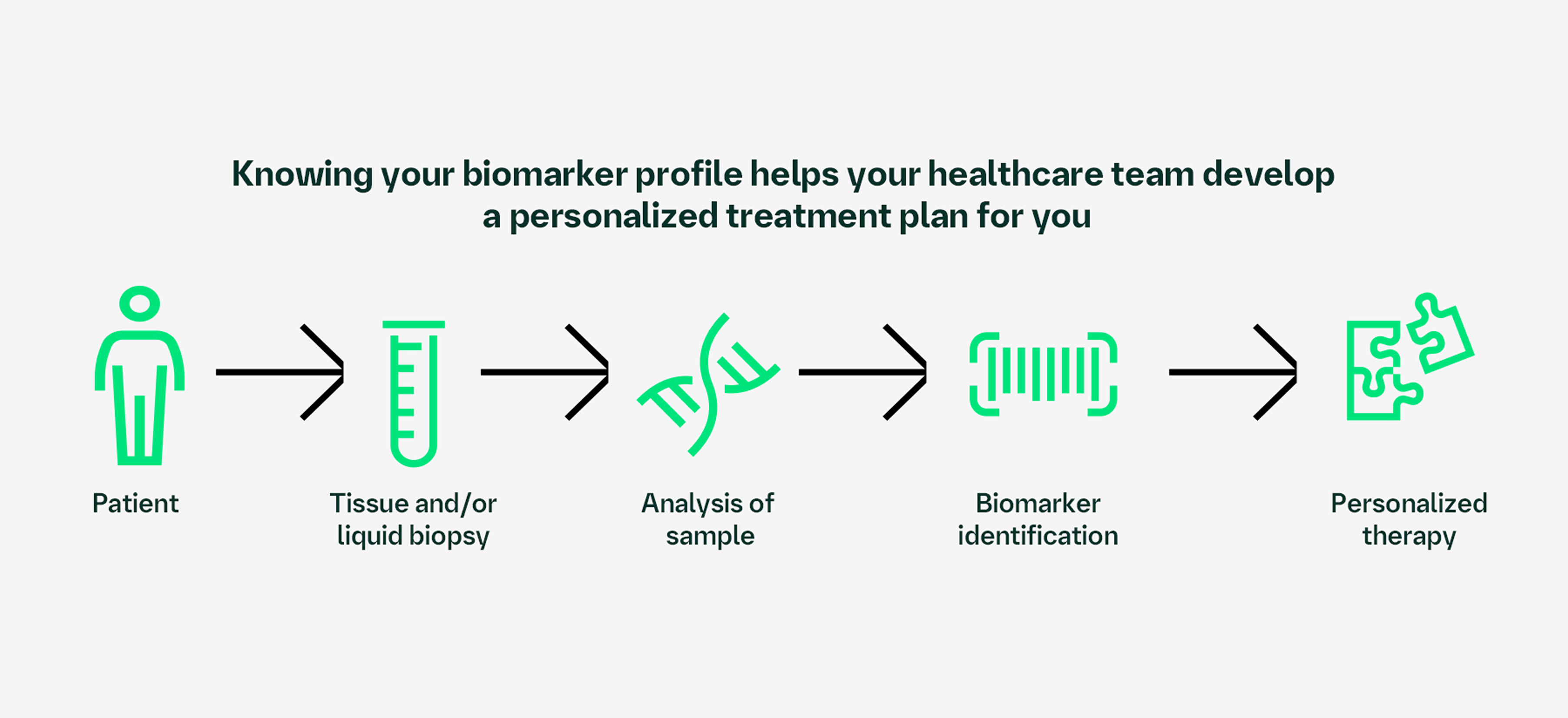
Some therapies target certain biomarkers. Testing for your cancer’s biomarker profile at diagnosis helps your healthcare team decide which treatment plan may work best for your unique lung cancer.
There are many different ways your doctor can test for biomarkers. What matters most is making sure a full panel of important biomarkers is checked–like HER2, EGFR, ALK and PD-L1–so your care team has the information needed to determine which targeted therapy may work best for you.
Identifying your biomarker profile
To learn about your biomarker profile, a sample of your tumour is collected and examined under a microscope. Your sample can be retrieved using a tissue or liquid biopsy.
You may feel nervous about your biopsy, but it is one of the most important steps in finding the best treatment option for you. Your healthcare team is there to answer any questions you may have about the procedure and to ensure you are safe and comfortable every step of the way.

Bronchoscopy: a thin, flexible tube is inserted through the mouth or nose into the lungs to collect a sample
Endobronchial ultrasound-guided transbronchial needle aspiration (EBUS-TBNA): a thin, flexible tube is inserted through the mouth into the airways where a needle will collect a sample from the lymph nodes
- Transthoracic needle biopsy: a thin needle is inserted through the chest wall into the lung to collect a sample

What your biomarker means for your diagnosis
Your biomarker testing may include all or some of the following biomarkers:
HER2 (ERBB2) | MET | BRAF | KRAS | ROS1 |
EGFR | NTRK | ALK | RET | PD-L1 |
These biomarkers are often found in healthy cells and act as a light switch to help regulate cell growth and division. Normally, cells cycle between “on” and “off”, growing when needed and resting when not. In cancer, changes to the tumour’s DNA can cause these biomarkers to get stuck in the “on” position, breaking the cycle and making your cells grow too quickly.
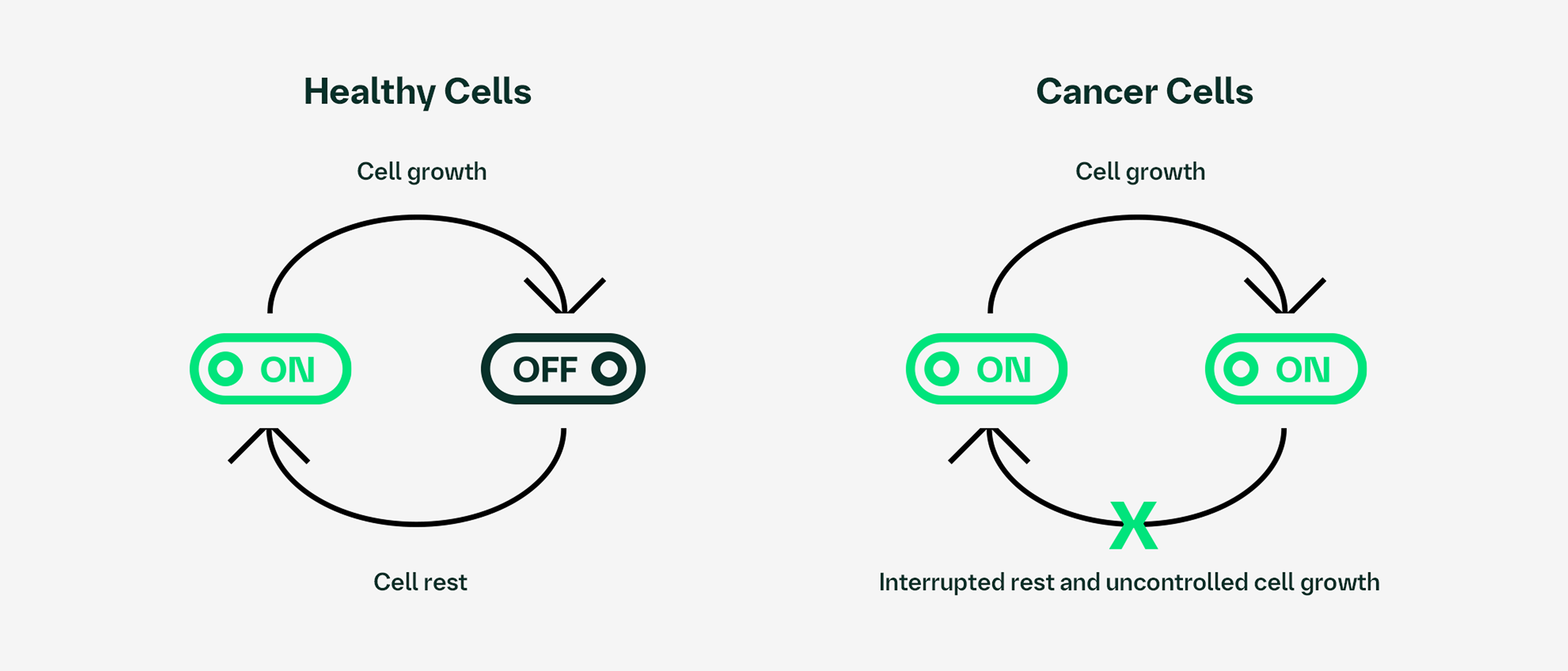
Your biopsy results can show which biomarker is driving cell growth in your tumour. From here, your doctor can identify available treatment options that target your biomarker.
Videos
Patient video
Biomarkers & me: a patient’s journey to personalized cancer care
Listen to Bev–a Canadian patient diagnosed with lung cancer–share her experience with biomarker testing and the role it played in shaping her cancer care plan.

00:09.844 --> 00:13.179
Hi, my name is Bev, and I live in Toronto, Ontario.
00:13.971 --> 00:15.056
Several years ago,
00:15.057 --> 00:17.923
I had two lingering colds six months apart.
00:18.013 --> 00:20.104
The second cold, I was coughing so much,
00:20.103 --> 00:21.730
I thought I had strep throat.
00:22.573 --> 00:25.234
I booked an appointment with my family doctor.
00:25.609 --> 00:27.576
And she fortunately
00:27.623 --> 00:31.156
ordered a chest x-ray as part of her examination.
00:31.306 --> 00:34.458
That decision of hers likely saved my life.
00:35.551 --> 00:37.506
At the end of various tests,
00:37.686 --> 00:39.858
my husband and I met with the doctor,
00:40.030 --> 00:44.294
and he gave us the diagnosis of stage 4 lung cancer.
00:44.923 --> 00:47.227
We knew something was very serious,
00:47.414 --> 00:51.260
but we were definitely not expecting stage 4 lung cancer
00:51.691 --> 00:54.513
or to be told that this would kill me.
00:55.559 --> 00:58.035
It was a shock because I’ve always been healthy
00:58.036 --> 00:59.434
and I’m a never smoker.
01:01.431 --> 01:03.146
Once we had the diagnosis,
01:03.228 --> 01:06.066
the doctor ordered a biomarker test,
01:06.289 --> 01:09.444
a tissue biopsy, to clarify
01:09.590 --> 01:13.234
what was the particular mutation that I had.
01:13.634 --> 01:17.119
It’s really important to know early in the cancer journey
01:17.303 --> 01:19.663
what the particular biomarker is.
01:20.220 --> 01:23.452
It is part of the trend towards precision medicine
01:23.926 --> 01:27.296
and provides the opportunity to give the best
01:27.467 --> 01:29.187
and most appropriate treatment
01:29.187 --> 01:31.121
for the particular biomarker.
01:31.674 --> 01:34.302
We got the results of the biomarker testing,
01:34.542 --> 01:37.431
and the doctors were really pleased to tell us
01:37.666 --> 01:40.601
that I had an actionable mutation.
01:41.154 --> 01:43.090
At the time, I didn’t understand
01:43.090 --> 01:44.688
what they were talking about.
01:45.162 --> 01:49.120
But I realized that they were able to select a
01:49.120 --> 01:52.487
targeted therapy for me that was specific
01:52.619 --> 01:54.614
to my particular mutation.
01:56.973 --> 01:59.703
When other people are in a similar situation,
01:59.704 --> 02:02.069
I think it’s really important that they
02:02.269 --> 02:04.748
appreciate the value of having a
02:04.782 --> 02:07.711
biopsy to determine their biomarker.
02:08.596 --> 02:10.028
When I learned more about
02:10.029 --> 02:12.799
targeted therapy and precision medicine,
02:13.066 --> 02:15.857
I realized that I was very fortunate
02:16.014 --> 02:17.565
to have had the test,
02:17.602 --> 02:20.511
let alone to have a targeted therapy
02:20.512 --> 02:23.060
specific to my type of cancer.
02:25.423 --> 02:26.897
The biomarker testing
02:26.976 --> 02:29.490
was the best thing that was done for me.
02:29.514 --> 02:32.374
It’s given me a high quality of life
02:32.981 --> 02:35.322
for a lot longer than they predicted.
Healthcare professional video
The power of biomarkers: advancing personalized cancer care
Medical oncologist Dr. Vishal Navani shares his experience with biomarker testing and the difference it has made for his patients diagnosed with lung cancer.

00:00:07.566 --> 00:00:08.926
I’m a medical oncologist.
00:00:08.946 --> 00:00:10.959
I care for patients with lung cancer,
00:00:10.973 --> 00:00:13.583
and I’ve been practicing for 14 years.
00:00:13.937 --> 00:00:16.000
Cells are the building blocks of the body.
00:00:16.150 --> 00:00:18.958
Every organ has billions and billions of cells.
00:00:19.351 --> 00:00:21.459
Cancer is a disease where those cells
00:00:21.544 --> 00:00:24.333
grow and divide in a disordered fashion.
00:00:24.660 --> 00:00:28.583
Biomarkers are the errors in a cell’s instructions,
00:00:28.702 --> 00:00:31.667
the problems in its code, its DNA,
00:00:32.425 --> 00:00:35.732
that make the cell grow in a
00:00:35.895 --> 00:00:38.333
disordered, aggressive fashion.
00:00:38.615 --> 00:00:41.209
So, understanding those biomarkers tells us
00:00:41.578 --> 00:00:44.083
the cell’s faulty instructions
00:00:44.348 --> 00:00:46.625
and allow us to better treat the disease.
00:00:47.214 --> 00:00:49.758
It’s critical to complete biomarker testing
00:00:49.778 --> 00:00:53.000
as early as possible in the diagnostic pathway.
00:00:53.701 --> 00:00:56.180
Biomarkers are critical to understand
00:00:56.254 --> 00:00:58.292
the nature, prognosis
00:00:58.502 --> 00:01:01.459
and treatment options for some patients with this disease.
00:01:02.072 --> 00:01:04.258
Biomarker testing is usually done on
00:01:04.278 --> 00:01:06.833
tissue collected from a patient with lung cancer.
00:01:07.586 --> 00:01:11.458
If we find an actionable biomarker in a patient’s cancer,
00:01:11.809 --> 00:01:13.848
it allows us to precisely
00:01:13.873 --> 00:01:15.250
tailor a treatment
00:01:15.756 --> 00:01:17.375
based on that unique cancer
00:01:17.409 --> 00:01:19.000
and that unique individual
00:01:19.223 --> 00:01:22.667
rather than using other less precise options.
00:01:23.262 --> 00:01:26.250
Without understanding the biomarker profile
00:01:26.585 --> 00:01:28.182
and confirming the diagnosis
00:01:28.328 --> 00:01:29.916
for a patient with lung cancer,
00:01:30.255 --> 00:01:31.125
we’re in the dark
00:01:31.330 --> 00:01:33.542
about prognosis and treatment options.
00:01:33.736 --> 00:01:34.977
Cancer care is moving
00:01:35.057 --> 00:01:37.750
every day towards more precise treatment.
00:01:37.934 --> 00:01:40.459
If you think about this disease like
00:01:40.487 --> 00:01:43.333
a garden that has weeds growing,
00:01:43.835 --> 00:01:46.917
but those weeds are in between normal flowers,
00:01:47.099 --> 00:01:48.709
you just want to kill the weeds
00:01:49.196 --> 00:01:51.142
and not affect your normal cells,
00:01:51.155 --> 00:01:53.003
your normal tissue, the flowers.
00:01:53.350 --> 00:01:55.980
Biomarkers allow precise therapies
00:01:56.287 --> 00:01:58.542
that are akin to weed whackers,
00:01:58.608 --> 00:01:59.791
getting rid of the weeds,
00:01:59.937 --> 00:02:01.959
but sparing the normal flowers.
00:02:02.525 --> 00:02:05.065
It’s critical that a patient ask whether
00:02:05.178 --> 00:02:07.484
that biopsy that proves
00:02:07.497 --> 00:02:08.917
that they have lung cancer
00:02:09.143 --> 00:02:11.666
has been tested for biomarkers
00:02:11.805 --> 00:02:13.975
to help inform prognosis
00:02:14.189 --> 00:02:15.959
and treatment option discussion.
The next best step
Understanding your diagnosis and biomarker profile is an important step in your journey. To learn more about lung cancer and biomarkers at your own pace, download the biomarker patient booklet. To help you prepare for your appointment with your healthcare professional, download the patient discussion guide – designed to help you ask the right questions about your biomarker testing.

Patient discussion guide

Biomarker patient booklet
HER2=human epidermal growth factor receptor 2; EGFR=epidermal growth factor receptor; ALK=anaplastic lymphoma kinase; PD-L1=programmed death-ligand 1; ERBB2=erb-B2 receptor tyrosine kinase 2; MET=mesenchymal epithelial transition factor receptor; BRAF=v-raf murine sarcoma viral oncogene homolog B; KRAS=Kirsten rat sarcoma viral oncogene homolog; ROS1=c-ros proto-oncogene 1; NTRK=neurotrophic tyrosine receptor kinase; RET=rearranged during transfection.